
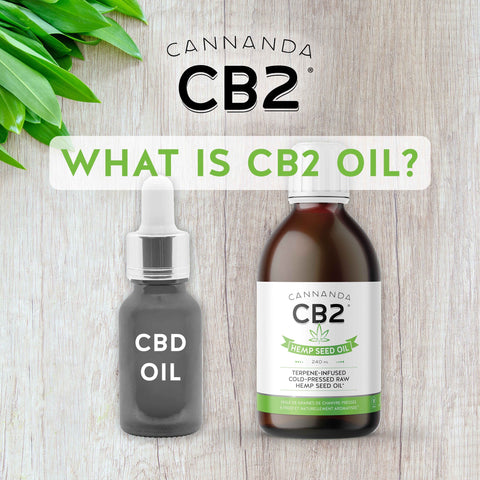
CB2 Oil vs CBD Oil: The Differences That Actually Matter
They sound alike. They're both sold for wellness. They both involve hemp. But they are fundamentally different products — and mixing them up can cost you more than you think.
You're looking at CB2 oil and CBD oil and wondering if they're basically the same thing. Or maybe you tried CBD and it didn't work, and someone mentioned CB2 oil. Or you need something that won't cause issues at a border crossing or on a drug test. This article walks through every meaningful difference between the two — clearly, without hype.
CB2 oil and CBD oil are not the same thing. CB2 oil is built around beta-caryophyllene (BCP), a terpene found in black pepper and cloves that directly activates CB2 receptors. CBD is a cannabinoid with a completely different mechanism, more complicated legal status, known drug interactions, and real drug-test risk. CB2 oil is legal everywhere, carries GRAS food-ingredient status, produces no intoxication, and has no known adverse drug interactions. The confusion between the two has real consequences — especially for travelers, athletes, and people on medication.
The naming overlap between CB2 oil and CBD oil has caused a lot of confusion. Both products reference the endocannabinoid system. Both come in dropper bottles. Both get marketed for pain, sleep, and anxiety. But underneath the surface-level similarities, these are completely different compounds with different mechanisms, different legal status, and meaningfully different safety profiles.
Cannanda invented CB2 oil. We've spent years watching people pick up CBD expecting CB2 results, or get turned away at a border with CBD they thought was legal, or fail a drug test after taking CBD they were told was "pure." This article exists because the confusion has real costs — and because you deserve a clear explanation before you spend money or take a risk.
What is CB2 oil, exactly?
CB2 oil gets its name from CB2 receptors — one of the two main receptors in the endocannabinoid system. CB2 receptors are found throughout the immune system and peripheral tissues. When you activate them, you get anti-inflammatory, analgesic, and immune-modulating effects without any of the psychoactive effects you'd get from CB1 activation.
Cannanda CB2 oil is a proprietary blend of terpenes — natural plant compounds found in herbs, spices, and fruits — with beta-caryophyllene (BCP) as the featured active ingredient. BCP is found in black pepper, cloves, copaiba balsam, and hemp. It's classified as a food ingredient, not a cannabinoid, and it has FDA GRAS status. It is, as far as the scientific literature is concerned, a dietary cannabinoid — a compound from food that activates cannabinoid receptors.
In 2008, Gertsch et al. published a landmark study in PNAS confirming that beta-caryophyllene is a selective CB2 agonist. "Selective" means it binds to CB2 receptors specifically — not CB1. This is important because CB1 is what produces psychoactive effects. BCP doesn't touch CB1, which is why it produces no intoxication, no impairment, and no positive drug test. The study also identified BCP as the first dietary compound known to directly activate the endocannabinoid system.
What is CBD oil?
CBD (cannabidiol) is a cannabinoid — a naturally occurring compound from the cannabis plant. Unlike THC, CBD is non-psychoactive on its own. But its pharmacology is more complicated than most people realize. CBD doesn't directly activate CB1 or CB2 receptors. Instead, it modulates the endocannabinoid system indirectly — through a wide range of mechanisms including TRPV1 channels, serotonin receptors, and inhibition of the enzyme that breaks down anandamide (your body's natural endocannabinoid).
Because CBD is a cannabinoid, it faces legal hurdles that terpenes like BCP do not. It's also metabolized by the same liver enzymes that handle most common medications, which creates interaction risk. And even "pure" CBD products carry contamination and degradation risks that BCP simply doesn't have.
The 8 differences that matter
Here's a quick comparison, then we'll walk through each one.
| Factor | Cannanda CB2 Oil | CBD Oil |
|---|---|---|
| Active ingredient | Beta-caryophyllene (terpene) | Cannabidiol (cannabinoid) |
| Legal to travel with | Yes — globally | Restricted in many countries |
| FDA GRAS status | Yes — food-grade safe | No — self-affirmed GRAS revoked |
| Drug test risk | None | Real risk (THC or degradation) |
| Drug interactions | None documented | Known CYP450 interactions |
| Activates CB2 receptors | Yes — directly | No — indirect only |
| Reported efficacy | ~60–70% | ~33% |
| Approved for pets | Yes — Health Canada VHP | No approvals for any species |
CBD still faces legal restrictions in a lot of countries. Crossing borders with it can result in confiscation or worse, depending on the jurisdiction. This catches people off guard because CBD feels mainstream in North America and parts of Europe — but that doesn't mean it's legal at every international border or customs checkpoint.
CB2 oil uses only food-grade terpene ingredients with no cannabinoids and no THC. That classification — food ingredient — means it travels cleanly in most jurisdictions. If you travel regularly and want natural support you don't have to leave at home, CB2 oil is the straightforward choice.
GRAS stands for Generally Recognized As Safe — an FDA designation that means an ingredient has been rigorously evaluated and is considered as safe as food. All ingredients in Cannanda CB2 oil carry GRAS status. Beta-caryophyllene has been in the human food supply for thousands of years. It's in black pepper. It's in cloves. You've been consuming it your whole life.
CBD's situation is different. The US FDA revoked CBD's self-affirmed GRAS status, citing unresolved safety questions around long-term daily use, liver effects at high doses, and interactions with other compounds. The FDA hasn't banned CBD, but it hasn't cleared it as GRAS either. That distinction matters if you're thinking about daily, long-term use.
This one's a bigger issue than people realize. CBD products — even ones labelled "THC-free" — are frequently found to contain trace levels of THC on third-party testing. The cannabis supply chain makes complete THC isolation difficult, and contamination is common. Some competitive athletes have been sanctioned after using CBD products they believed were clean.
Beyond contamination, even pure CBD can degrade over time into compounds that flag positive on tests for banned substances. BCP doesn't have any of these issues. It's a terpene. Standard drug screens don't test for it. Cannanda CB2 oil contains 0% THC and 0% CBD.
CBD is processed through the cytochrome P450 (CYP450) enzyme system — the same liver pathway that metabolizes most common medications. This means CBD can affect how quickly your body clears other drugs, raising or lowering their effective levels in your system. This is the same reason you see grapefruit warnings on certain medications. CBD has known interactions with statins, blood thinners like warfarin, antidepressants, anti-seizure medications, and more.
At Cannanda's recommended doses, CB2 oil has no documented adverse drug interactions. If you're on multiple medications, that's a meaningful distinction.
We see a 60–70% efficacy rate with CB2 oil across our customer base. The reported success rate for CBD products is around 33%. That gap is significant. Some of the difference comes down to mechanism — BCP directly activates CB2 receptors, while CBD works indirectly through multiple pathways that vary more from person to person. Some of it comes down to bioavailability — BCP is a small, fat-soluble molecule that absorbs efficiently, while CBD has notoriously poor oral bioavailability.
If you tried CBD and it didn't do much, that's not unusual. A lot of people who switch to CB2 oil find it works when CBD didn't.
CBD has a bioavailability problem. Unless you're vaping it (which brings its own risks), oral CBD products lose a significant portion of the active compound in digestion and first-pass liver metabolism before it ever reaches your bloodstream. This is why you see such high doses in commercial CBD products — you need a lot of it just to get enough through.
Beta-caryophyllene is small, fat-soluble, and lipophilic — it crosses biological membranes efficiently. It absorbs through the skin. It crosses the blood-brain barrier via inhalation. Taken sublingually in a carrier oil, it bypasses first-pass metabolism and enters the bloodstream directly. You get more effect from a smaller amount.
This is the mechanistic difference that explains a lot of the others. CB2 oil contains BCP, which is a direct CB2 receptor agonist — it binds to and activates CB2 receptors specifically. CBD does not activate CB1 or CB2 receptors directly. CBD modulates the endocannabinoid system through indirect pathways, including inhibiting the breakdown of endogenous cannabinoids and influencing other receptor systems.
Direct activation means more predictable, more consistent effects. Indirect modulation means more variability — which helps explain why CBD works well for some people and not at all for others.
Cannanda CB2 Dog-Ease Hemp Seed Oil has been approved by Health Canada as a Veterinary Health Product. That's a formal safety and efficacy evaluation — not just a marketing claim. No CBD product has received equivalent veterinary approval from any regulatory body for any animal species. Vets and animal health professionals aren't permitted to recommend CBD products for pets.
There's also the contamination issue. Dogs are more sensitive to THC than humans, and CBD products frequently contain undisclosed THC. For your dog, CB2 oil isn't just a better option — it may be the only responsible one.
Cannanda invented CB2 oil and built the category from scratch. Other brands have since started selling BCP products and calling them "CB2 oil" to ride the goodwill and recognition we established. Some of these products may use BCP — the right active ingredient — but the formulation, quality, concentration, and supporting terpene blend vary significantly from product to product. Counterfeit products have also been reported to be void of the active ingredients, and known to contain heavy metals, pesticides, and solvent residues.
Cannanda's CB2 oil is a proprietary blend. BCP alone isn't the whole story — the full terpene profile matters for stability, absorption, efficacy, and the entourage effect. When you're looking at any "CB2 oil" that isn't Cannanda, it's buyer beware.
Ready to try the real thing?
CB2 oil. No THC. No CBD. No drug test risk. Legal everywhere. Made by the company that invented it.
Shop Cannanda CB2 OilFrequently Asked Questions
Is CB2 oil the same as CBD oil?
No. CB2 oil and CBD oil are completely different products. CB2 oil is based on beta-caryophyllene (BCP), a terpene — not a cannabinoid. BCP directly activates CB2 receptors and has FDA GRAS status as a food ingredient. CBD is a cannabinoid that works through different pathways and has a more complex regulatory and safety profile.
Why is CB2 oil legal to travel with but CBD oil often isn't?
CB2 oil uses only GRAS-status terpene ingredients — no cannabinoids, no THC. That puts it in the food ingredient category in most jurisdictions, making it safe to carry across international borders. CBD is classified as a cannabinoid and still faces legal restrictions in many countries. If you travel internationally and want to bring your wellness product with you, CB2 oil is the safe choice.
Will CB2 oil show up on a drug test?
No. CB2 oil contains no THC and no cannabinoids. Beta-caryophyllene is a terpene — it's not screened for on any standard drug test. CBD products carry real risk: they may contain trace THC from contamination, and even "pure" CBD can degrade into compounds that trigger positive results. Cannanda CB2 oil is 0% THC, 0% CBD.
Does CB2 oil interact with medications?
At Cannanda's recommended doses, there are no documented adverse drug interactions with CB2 oil. CBD is metabolized through the CYP450 liver enzyme pathway — the same pathway as many common medications — and has documented interactions with statins, blood thinners, antidepressants, and anti-seizure drugs. If you're on multiple medications, this difference matters.
What does GRAS status mean?
GRAS stands for Generally Recognized As Safe — a US FDA designation that means an ingredient is considered as safe as food. All ingredients in Cannanda CB2 oil have GRAS status. Beta-caryophyllene is found in black pepper, cloves, and many spices — humans have been consuming it for thousands of years. CBD's self-affirmed GRAS status was revoked by the FDA, leaving open questions about its long-term safety profile.
I tried CBD and it didn't work. Should I try CB2 oil?
Yes — and a lot of people who switch from CBD to CB2 oil find that it works when CBD didn't. The mechanisms are different. BCP directly activates CB2 receptors, which is more targeted and produces less person-to-person variability than CBD's indirect mechanism. CB2 oil also absorbs better. If CBD underwhelmed you, CB2 oil is worth trying.
Does CB2 oil get you high?
No. Beta-caryophyllene only activates CB2 receptors — not CB1. CB1 activation is what produces the psychoactive effects from THC. BCP doesn't touch CB1, so there's no intoxication, no impairment, and no psychoactive effects whatsoever.
Is CB2 oil safe for my dog?
Yes. Cannanda CB2 Dog-Ease Hemp Seed Oil is approved by Health Canada as a Veterinary Health Product — a formal safety and efficacy evaluation. No CBD product has received any equivalent veterinary approval anywhere in the world. Dogs are also more sensitive to THC than humans, and many CBD products contain undisclosed THC. For pets, CB2 oil is the safer, better-supported option.
Are there other brands selling "CB2 oil"? Are they the same?
Cannanda invented CB2 oil and created the category. Since then, other brands have started using the "CB2 oil" name on their BCP products to benefit from the recognition Cannanda built. The active ingredient, beta-caryophyllene, may be correct, but the full formulation matters. Cannanda's CB2 oil is a proprietary terpene blend, not just BCP in a carrier oil. The supporting terpene profile contributes to the overall effect, stability, and absorption. If you're comparing products, the "CB2" name alone doesn't guarantee you're getting the original formulation — it must say "Cannanda CB2" or you risk buying counterfeit products that might contain less beta-caryophyllene than what's claimed on the label, or worse, be contaminated with heavy metals, pesticides, and solvent residues.
References
- Gertsch, J., Leonti, M., Raduner, S., Racz, I., Chen, J. Z., Xie, X. Q., ... & Zimmer, A. (2008). Beta-caryophyllene is a dietary cannabinoid. PNAS, 105(26), 9099–9104.
- Bento, A. F., Marcon, R., Dutra, R. C., Claudino, R. F., Cola, M., Leite, D. F., & Calixto, J. B. (2011). β-Caryophyllene inhibits dextran sulfate sodium-induced colitis in mice through CB2 receptor activation and PPARγ pathway. American Journal of Pathology, 178(3), 1153–1166.
- Klauke, A.-L., Racz, I., Pradier, B., Markert, A., Zimmer, A. M., Gertsch, J., & Zimmer, A. (2014). The cannabinoid CB2 receptor-selective phytocannabinoid beta-caryophyllene exerts analgesic effects in mouse models of inflammatory and neuropath









Comments
Hi I have Myasthenia Gravis so needless to say I am drawn to this as I feel it will help autoimmune diseases. Also to help lose weight and relieve symptoms of MG. Which do I order?
I am looking for arthritis in myself & my dog plus stomachs issues for myself. I have a thyroid issue & wondering if that hinders taking this product. Very interested. Thank you
Which product is suppose to help in weight loss
Is there any ( known or unknown) interaction with thyroid medications or hypothyroidism? I know CBD might interfere with the same pathway and affect the absorption of synthroid so I’m not comfortable taking it. Is there any reliable studies or info with the CB2 Wellness product that I would use for anxiety?
Also are there any testimonials of CB2 Wellness and its effectiveness with reducing anxiety?
Thank you
Ordered and received in less than 24 hours!
I’ve used the CB2 Wellness for two nights now, and it’s been very effective for me. Impressed with both the fast delivery and the product itself.
Hi I suffer from very severe Migraine headaches and anxiety was looking for some information about your products that could possibly help I have very severe pain and have tried many different medications but nothing has worked for me I get very bad nausea and sensitivity to light and smells and sometimes get migraines that last for days at a time and the pain is debilitating and unbearable and was wondering if any of your products may be able to help me I have been struggling for years I really need help I have no Life and am always have chronic pain! Help!
Hi I’m interested in this product but I’m confused on which one to get. I’m looking for something for arthritis in my dog and husband.